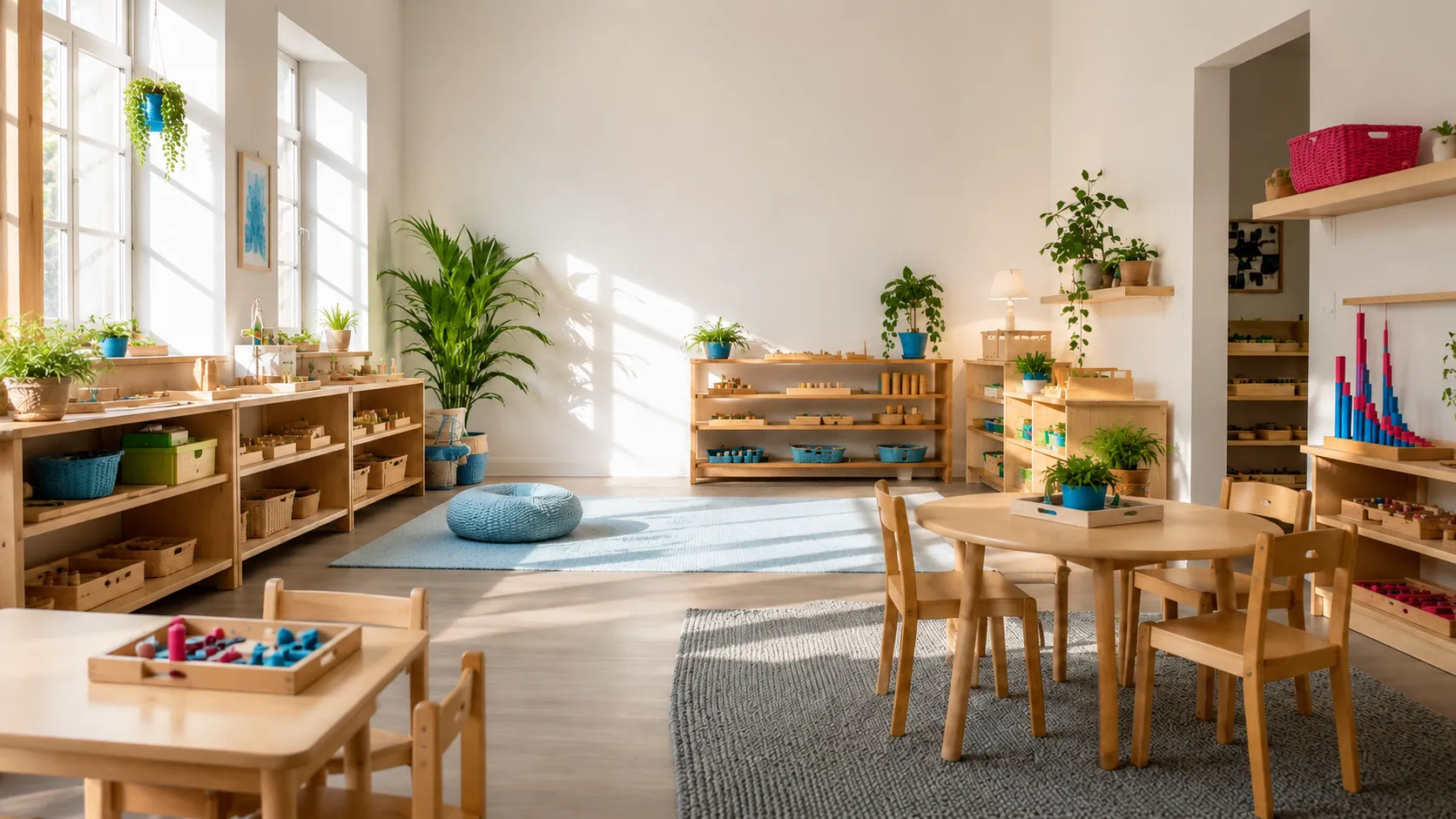
Online Montessori training

International certification • Montessori Guide

Become a Montessori Guide 100% online

International Montessori diploma courses issued by AMMAC — at your own pace and with expert mentorship, so you can study online from any country. Enroll today and reserve your spot in the upcoming cohort.

We are the Montessori Association of Mexico — AMMAC (Asociación Montessori de México A.C.) — a Mexican institution with international reach: we train Montessori Guides online for students all over the world.

  • AMMAC Montessori certification
  • Developed with reference to MACTE / AMI
  • 100% online
  • Google for Education
  • CONOCER competency standard (SEP)
See all programs and pricing →

Enrollment special

Next online diploma course

Transform the way you accompany children.

Calculating the next start date…

Enrollment + portal access

$5,900$4,900MXN

One-time enrollment fee with lifetime access to the institution. Monthly tuition depends on the program you choose.

Transparent pricing

What you pay today

A one-time enrollment fee of $4,900 MXN. If you choose the full start option, you also cover your program's first payment in this same step.

What you pay later

Guide certification programs from $3,100 MXN per month, or short diploma courses from $2,800 MXN. The enrollment fee is never charged again.

🌐

100% online

Study from anywhere

Immediate application

Hands-on Montessori approach

👥

Expert mentorship

Certified Guides

🎓

One-time enrollment fee

No repeat fee when you switch programs
MEANINGFUL LEARNING

In meaningful learning, students are invited to take an active part in their own learning process, connecting new concepts to their prior knowledge and their environment. The goal is for students not merely to take in information passively, but to understand it, make sense of it, and integrate it into their own cognitive structure.

In other words the child creates his own movements and, having done so, perfects them.

No one can be free unless he is independent

The hands are the instruments of man's intelligence.

In other words the child creates his own movements and, having done so, perfects them.

No one can be free unless he is independent

The hands are the instruments of man's intelligence.

In other words the child creates his own movements and, having done so, perfects them.

No one can be free unless he is independent

The hands are the instruments of man's intelligence.

In other words the child creates his own movements and, having done so, perfects them.

No one can be free unless he is independent

The hands are the instruments of man's intelligence.

In other words the child creates his own movements and, having done so, perfects them.

No one can be free unless he is independent

The hands are the instruments of man's intelligence.

No one can be free unless he is independent

The hands are the instruments of man's intelligence.

In other words the child creates his own movements and, having done so, perfects them.

No one can be free unless he is independent

The hands are the instruments of man's intelligence.

In other words the child creates his own movements and, having done so, perfects them.

No one can be free unless he is independent

The hands are the instruments of man's intelligence.

In other words the child creates his own movements and, having done so, perfects them.

No one can be free unless he is independent

The hands are the instruments of man's intelligence.

In other words the child creates his own movements and, having done so, perfects them.

No one can be free unless he is independent

The hands are the instruments of man's intelligence.

map

All our diploma courses include:
International Certification

Mexican flag
United States flag
Colombian flag
Argentinian flag
Canadian flag
German flag
English flag

Montessori certifications are highly regarded all over the world

Montessori Association of Mexico (Asociación Montessori de México A.C.) — AMMAC

  • 1965

    Founding of AMMAC

    Founded by Dr. Angelina Almeida to introduce and promote the pedagogy and philosophy of Maria Montessori's method in Mexico, the Asociación Montessori de México A.C. (AMMAC, the Montessori Association of Mexico) was born — becoming one of the first formally constituted organizations dedicated to the professional training of Montessori Guides, the opening of schools, and the study of the Montessori method.

  • 1966

    AMMAC creates the first Montessori school in Mexico City: Escuela Montessori Kalpilli

    In the year of its founding, AMMAC opened the doors of Escuela Montessori Kalpilli, the first Montessori school in Mexico City. Originally located in the Polanco neighborhood, Montessori Kalpilli began its work offering an education based on Maria Montessori's scientific pedagogy, whose method and philosophy center on the development of the whole child.

  • 1967

    First open pedagogical showcase

    The Asociación Montessori organized, at Escuela Montessori Kalpilli, the first pedagogical showcase open to the public and the press, aimed at sharing and demonstrating the application of the Montessori method, the use of the materials, and the importance of Montessori presentations. These showcases have become an AMMAC tradition, held year after year at Escuela Montessori Kalpilli.

  • 1970

    AMMAC's role in the creation of Montessori schools

    During its early years, AMMAC took part in the creation and development of Montessori schools across the country — producing study programs, distributing Montessori materials imported directly from Italy, and training Montessori Guides at a professional level.

  • 1984

    AMMAC and the Government of Tabasco

    AMMAC formed an alliance with the government of Tabasco to jointly develop a pedagogical training program for Nahua, Chontal, Maya, Zapotec, Totonac, and Mixe teachers.

  • 1992

    Montessori Kalpilli in San Pedro de los Pinos

    Escuela Montessori Kalpilli found its new home in the San Pedro de los Pinos neighborhood. Among books, learning, Montessori materials, fairs, camps, and a great deal of love, Kalpilli and the Asociación Montessori de México have made history, building a community by and for children, with a humanistic, innovative education that has now seen more than 50 graduating classes.

  • 1997

    Training program for rural schools

    AMMAC created a Montessori method training program for teachers in rural schools, along with workshops for producing low-cost Montessori materials and furniture from renewable resources. Through this program, projects to open Montessori schools have been carried out in rural areas of Veracruz, Guerrero, and Oaxaca.

  • 2005

    International professional certifications for Montessori Guides

    AMMAC began offering professional training for Montessori Guides, standing out as the only one officially recognized by the National Autonomous University of Mexico (UNAM), the Metropolitan Autonomous University (UAM), and the Universidad del Valle de México, while also meeting the international competencies and agreements under which AMMAC grants its international certifications.

  • 2014

    Online professional certifications for Montessori Guides

    In collaboration with Google Classroom, AMMAC created the first version of its online Montessori Guide certification diploma courses — becoming the first training school to offer distance diploma courses and the first educational organization in Mexico linked to Google Classroom. Since then, online certifications have been part of AMMAC's educational offering, which has developed a personalized teaching methodology with audiovisual and interactive materials.

  • 2016

    AMMAC takes part in international projects

    From this year on, AMMAC has designed and coordinated courses and diploma courses in countries such as Colombia, Puerto Rico, Spain, Costa Rica, the United States, Israel, Switzerland, and India — serving the Spanish-speaking population of each of these regions and contributing to the translation, into different languages, of many of the courses designed by AMMAC for presentation at international educational centers.

  • 2018

    AMMAC creates its publishing imprint

    A series of books in Spanish based on Maria Montessori's original works is born, each accompanied by an updated review of the method. Answering Dr. Montessori's own call, the pedagogy must be constantly reviewed and renewed — not only because of scientific advances, but also, and above all, through the ongoing observation of children, who continue to guide us toward paths that allow us to keep serving their development. The imprint has already published 3 titles, available on Amazon and directly from AMMAC.

  • 2020

    AMMAC's contributions to educational research during the global COVID-19 health emergency

    In response to the global health emergency, AMMAC joined a network of schools from different parts of the world to jointly conduct research on learning processes during the health crisis, schools' capacity to adapt, the development of pedagogical strategies for working with children remotely, and the recording and analysis of indicators of how the transformations of educational models — and their aftermath — affected children's educational development.

  • 2023

    Alignment with international standards and AMI foundations

    The training program is fully aligned with official international standards and developed with reference to AMI foundations: it covers their essential bases and incorporates new complementary content that enriches the training — observation, educational psychology, neuroeducation, inclusive education, psychomotor development, music therapy, and creative intelligence — contextualized to Mexico's educational reality.

  • 2025

    60 years of the Asociación Montessori de México

    In 2025, AMMAC celebrates 60 years of promoting Montessori pedagogy and philosophy in Mexico: six decades of training Guides, opening schools, conducting research, and building an educational community committed to a humanistic, innovative education.

  • 2026

    RVOE application in process with Mexico's SEP

    In 2026 we are pursuing the RVOE application with Mexico's Ministry of Public Education (SEP) so that, in addition to their international scope, our certifications carry official recognition in Mexico backing our graduates' training.

Learning objectives framework

Aligned with international Montessori training

Our diploma course organizes the entire training into seven competency domains, mirroring the international Montessori training domains (MACTE / AMI), developed with reference to AMI foundations. Each domain is developed across the six cognitive levels of Bloom's Taxonomy, so the training doesn't just deliver content: it builds understanding, judgment, and the capacity to create.

D1

Philosophical and Historical Foundations

The philosophical, scientific, and historical foundations of the method: Maria Montessori's life and work and the principles that sustain the pedagogy.

D2

Human Development and the Planes of Development

Human development across the planes of development and the characteristics of each period — the foundation for accompanying children.

D3

The Prepared Environment and the Materials

The design of the prepared environment and the knowledge, presentation, and purpose of each of the Montessori materials.

D4

Scientific Observation

Observation as a scientific tool: recording, interpreting, and responding to the real needs of each child.

D5

Role and Transformation of the Adult (the Guide)

The adult's inner preparation and transformation to become a Guide: attitude, ethics, and service to the child's development.

D6

Pedagogy of the Curriculum Areas

Pedagogical mastery of the Montessori curriculum areas and the sequence of presentations within them.

D7

Community, Family, and Leadership

The bond with families and the school community, and the Guide's leadership inside and outside the environment.

Six cognitive levels

Each domain develops progressively through Bloom's Taxonomy, from initial recognition all the way to creation.

  1. 1RememberRecognize and recall the fundamental concepts.
  2. 2UnderstandExplain ideas and make sense of them in your own words.
  3. 3ApplyUse what you've learned in real situations in the environment.
  4. 4AnalyzeDistinguish parts, relationships, and principles.
  5. 5EvaluateAssess, justify, and make pedagogical decisions.
  6. 6CreateDesign and propose new solutions and materials.

Every activity in the diploma course has a learning objective coded as “Domain·Level” — for example, D1·Analyze: the domain (D1–D7) indicates the area of competency, and the Bloom's Taxonomy verb indicates the cognitive level you are expected to develop. That way, every task you complete has an explicit, assessable learning purpose.